
Iconic Moments In Music: The Image That Came to Define Woodstock ’94
, by Behind The Gallery, 14 min reading time
, by Behind The Gallery, 14 min reading time
How one photograph of Trent Reznor covered in mud became the defining image of Woodstock '94 and one of rock's most iconic photographs.
Some performances are remembered for how they sounded. Others for how they felt. And then there are rare moments where a single image becomes the way the event itself is understood.
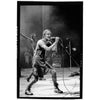
For Woodstock '94, that image is Trent Reznor covered in mud, gripping a microphone stand, captured by photographer Joseph Cultice.

By the time Nine Inch Nails took the stage, the band was already reshaping the mainstream. The Downward Spiral had pushed industrial music into wider consciousness without compromise. Woodstock should have been a moment of arrival. Instead, it became something far more physical.
Rain had turned the festival grounds into thick, contaminated mud. For most artists, it was a condition to manage. For Trent Reznor, it became part of the performance. By the time the set began, he was already submerged in it, dragging himself across the stage, gripping the mic stand less as a prop and more as something to hold onto.
The image that emerged from that moment would go on to define not just the performance, but the visual memory of Woodstock '94 itself.
Inside the Moment
Joseph Cultice wasn't observing from a distance. He was inside it.
"I felt like part of an intense moment, something epic," he recalls. "We were all having so much fun."
That sense of immersion shaped everything. There was no clean line between performer, photographer, and environment. Cultice moved freely across the stage, unrestricted and, by his own admission, on just a little mushrooms.
"I felt for the dudes and their crew," he says. "Like the band was about to scream into the void of this chasm of humanity… on live TV, no less."
Rather than shooting from designated positions, he just went for it.
"No rules," he says. "Got yelled at because I was all over the stage."
Trent Reznor noticed. "Trent Reznor was really pleased I was there, that I didn't just sit in the safe zones and shoot."
That lack of restriction, physical, creative, and otherwise, is embedded in the image itself. It doesn't feel composed. It feels caught.

The Frame That Held the Entire Performance
What gives the photograph its staying power is its timing.
"I think the vibe actually holds the entire moment," Cultice says. "Still deep in the mud, angsty, struggling… which they were. But also, right on the edge of something breaking open."
Reznor is not captured in release, but in compression, energy building, not yet discharged.
"The tension about to release in a massive, moment-changing way."
That's what allows the image to stand in for the entire performance. It doesn't show the peak. It shows the pressure before it.
Plus, as Cultice puts it: "It was in focus."
An Image That Outgrew the Contact Sheet

At the time, the photograph didn't immediately stand out, even to the people closest to it.
When Cultice recently scanned the original contact sheets, he found Trent Reznor's edit marks across the frames surrounding this one. Not on this one. The image that would come to define Woodstock '94 had been passed over in the initial edit, surrounded on all sides by frames that were chosen and this one that wasn't.
The labs were little help in cutting through the noise either.
"Because of the massive amount of film coming into the labs Monday morning, the labs in NYC were completely overwhelmed," Cultice recalls.
And yet, even within that chaos, there were early signals.
"Friends at the Arista black-and-white lab called me," he says. "They were like — wow… you were really right in the mix. Told me straight — these were gold."
Still, the image didn't dominate. It wasn't widely circulated at the time. What changed everything came later, ‘Then Trent did the HBO doc, and asked to use this image — suddenly it becomes more relevant’ That decision, Reznor reaching back past his own original edit to select the image he'd initially overlooked, is what elevated the photograph from contact sheet curiosity into the defining visual of the event.
"At the time, the TV footage felt important," Cultice reflects. "But in the end, the images really lived on."
The Image That Replaced the Memory
In the decades since, Woodstock '94 has been remembered through many performances. But visually, this is the frame that endures.
Not because it was the most obvious at the time. Not because it was the most widely published. But because it contains the entire moment — environment, tension, and release — in a single image.
Even Cultice didn't fully see it immediately.
"When did I realise I had something special?" he says. "Thirty years later."
The photograph was featured at the Rock and Roll Hall of Fame when Nine Inch Nails were inducted in 2020, cementing its place as the visual document of that performance. And the legacy it represents shows no sign of fading. In April 2026, Reznor brought that same uncompromising intensity back to a festival stage, performing as Nine Inch Noize, his collaboration with producer Boys Noize, at Coachella 2026 to near-universal acclaim, with critics naming the set one of the highlights of the weekend. The mud is long gone. The photograph remains.

Why Collectors Are Drawn to the Woodstock '94 Image
What draws collectors to this photograph is its position as the defining visual of Woodstock '94. While the festival featured dozens of performances, this frame of Trent Reznor, submerged in mud, gripping the microphone stand, has come to replace the broader memory of the event itself. It doesn't just document the performance; it has become the way the performance is understood.
For collectors, this is where an image moves beyond documentation into cultural authorship. The photograph captures the exact point where Nine Inch Nails' intensity, the physical environment, and the wider shift in alternative music converge into a single, legible moment. Crucially, it is not a retrospective symbol, it is the image that the band themselves returned to, decades later, to represent who they were.
Why This Image Endures as a Collectible
Limited Edition Significance
While the Woodstock '94 performance has been documented across video and photography, this image stands apart as the frame that came to represent it. Limited edition prints return the photograph to its origin, the contact sheet moment before it became the defining visual of the event.
For collectors, ownership is not about revisiting a famous performance. It is about holding the image that came to define it.

CLICK HERE to see the Nine Inch Nails Woodstock Collection