
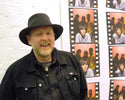
Behind the Lens: Ian Tilton
, by Behind The Gallery, 12 min reading time
, by Behind The Gallery, 12 min reading time
Go behind the lens with Ian Tilton — the photographer who captured Nirvana, The Stone Roses and the defining moments of 90s alternative rock.

We are thrilled to introduce Ian Tilton — the Blackpool-raised, Manchester-forged photographer whose work documented some of the most vital moments in British and American rock history. Known for his raw, documentary instincts and a rare gift for catching bands off-guard and fully alive, Ian's archive spans the Stone Roses' rise from South Manchester obscurity to world domination, a formative road trip with Nirvana through New York and Seattle, and a roster of subjects including Guns N'Roses, Happy Mondays, The Cure, and New Order. His photograph of Kurt Cobain weeping backstage after a show, taken in Seattle in 1990, has been named among the top ten most iconic rock photographs ever taken by Q Magazine, and featured in the celebrated book Who Shot Rock & Roll. Ian's limited edition prints are now available through Behind The Gallery.
Can you share your journey into music photography and what drew you into it?
It started because of music, and because of something that was happening to me physically. I was going deaf and because of that, music became something I was constantly drawn toward rather than away from. My brother was in a band, so I was already close to that world. I started taking a few photographs at gigs, and the bands loved it, because back then nobody had a photographer. To have a camera at all was unusual. Film was expensive. So whenever I'd take pictures and show them, the reaction was always “ oh, can you do some more of those”? It gave me a way in.
I couldn't communicate easily because people didn't know how to talk to someone who was deaf. There wasn't the patience, and we were young. But having a camera gave me a way to socialise even when I couldn't fully participate in the conversation. It integrated me. It was a really nice thing that came out of what felt like a very isolating time.
You turned down a place at Newcastle and instead took a professional photography course in Blackpool — what did that period teach you?
It was an expensive course, so I had to earn money in order to survive. The grant wouldn't sustain me. I learned the rudiments of business on the hoof, more than I would have if I'd been cushioned. After three years I had to make a choice: London or Manchester. I went to see the Sunday Times, tried to get work as an assistant with people like David Bailey, and quickly realised how much of a closed shop it was. London was expensive, difficult, sewn up. Manchester was different. It had Factory Records. It had an indie scene that wasn't just Factory, there was so much great stuff happening that people outside didn't even know about. So in 1985 I set myself up in business there and never stopped.
"I found something I really enjoyed that I could do, which was music. Even though I couldn't always communicate, the camera gave me a way in."

How did your relationship with the Stone Roses come about? It seems like it didn't begin as a sure thing.
My first encounter with them wasn't promising, to be honest. I was doing a piece on the Haçienda and the original manager, Howard Jones, played me some music and showed me some photos of this band he was managing. The pictures were awful, bandanas, black leather, spiky hair, nothing cohesive. The music was crappy. I passed. That was 1986.
Cut to a couple of years later and I'm working for Sounds magazine, and we get a commission to photograph this band from South Manchester. When they turned up I realised, it’s them. But their image had completely transformed. They looked great. They gave me a record and I put it on the turntable and it was Sally Cinnamon. I played it over and over. They'd completely got their act together.
We clicked that day. I think I stuck my neck out for them at one point, did something that showed I was on their side and after that they'd just ring me whenever they wanted pictures. I photographed them for about three and a half years, for multiple magazines. Everyone wanted to photograph them from 1988 onwards, so eventually they moved on to other photographers. But we had some really great times, and I brought out a book on them. I'm proud of that.
John Squire would bring his paintings to your house to be photographed for single covers. What was that collaboration like?
He'd turn up at my house with these Jackson Pollock-style canvases, glossy paint, almost from a hardware store, squiggles of colour colliding in ways that were surprisingly beautiful. We'd pour over them together and just look. I'd say, I really like the way that yellow bleeds into the black and the blue in this corner. He'd say, yeah, let's pull the camera out. We did about four of them, all of which ended up on record sleeves. They were uncredited, but I was never formally part of the creative process, I was just there with him, looking carefully. I think he appreciated that I took the time and genuinely engaged with what he was doing.
"After a while they just get totally used to you and you become part of the furniture — mobile furniture. And that's when you get the real shots."
Your work has a rawness to it, unfiltered, human. How do you approach photographing artists in a way that captures who they are rather than just the performance?
It's just a case of hanging out. That's it, really. A lot of working with bands is about waiting, hurry up and wait. You're waiting for a gig, waiting for the studio, waiting for a band member who may or may not turn up. Rennie from the Roses was notorious for it. Bez from the Happy Mondays, absolutely notorious. So you have to be deeply, almost unnaturally patient. And early on, I was.
When you arrive, people are aware of the camera. They goof around, they play up to it. But after a few hours, they just forget you're there. You become furniture. Mobile furniture. You move around, you lift the camera, and they just let it happen. Sometimes you get an amazing goofy shot, like Ian Brown with the orange in his mouth, because they've completely relaxed into your presence. Those documentary shots are what I'm really known for, and honestly, they're what I'm most proud of, because you're not selling anything. If you weren't there, the band would be doing the exact same thing. That's the truth of it.
People say they can identify your work by a sense of humour in it. Was that a conscious choice?
I was brought up aesthetically on Factory Records, all those 80s bands, Echo and the Bunnymen, early U2. Stylised, mystical, humorless. I love those pictures, but that wasn't the direction I wanted to take. Life is funny. And those funny moments are actually harder to capture than the serious ones — when it happens, you've got to click it fast. You've got to have film in the camera, you've got to have the technical side absolutely dialled in so that when the moment arrives, nothing is standing between you and the shot. Bands often regret those pictures, by the way, lead singers especially. But give it twenty years and they know they're great shots. They're the ones that feel like a diary, images that bring back what it was actually like before the world got involved and the vetoing started.

Tell us how the Nirvana relationship began? You were there remarkably early.
It was the New Music Seminar in New York. Sub Pop brought Tad and Nirvana over, they were virtually unknown in Europe at that point. I went over with journalist John Robb and Sub Pop's UK press agent Anton. We all slept on the floor of a tiny Manhattan apartment, about twelve bodies, pretty stinky. Sub Pop were asked which band they should put on the cover of Sounds: Tad or Nirvana? So we hung out, I photographed both.
Nirvana smashed their instruments at the gig, which I'd seen before, The Who, etc and found slightly contrived, if I'm honest, even though I enjoyed it and got great pictures. I was actually slightly more taken with Tad, who were more gregarious. Kurt was quite shy. In the end, we did a composite, both bands on the cover together. It was the first major European feature on either of them.
The story took a strange turn when, after CBGBs one night, a Greyhound bus hit me in the rain. Knocked me over, smashed me into a parked car, I kept hold of my camera bag, of course. I was laid up in the apartment for three days. The bands I was supposed to be shooting had to come to me. Nirvana would come back in the evenings with pizza. They were grateful to us, grateful that we'd put them on a cover when no one else in Europe was paying any attention. That mattered.
What separates an everyday music photograph from one that people still care about decades later?
The first thing is whether the audience connects with the subject. I've taken thousands of great pictures of bands that nobody remembers because the band never made it. That's just the reality. But beyond fame, there's something else, social and cultural history. Pictures of audiences, of ordinary people in a particular moment, matter too. You look at photographs from the late 80s and early 90s: no phones, no cameras in the crowd, fashions that look almost ancient now, the particular grain of film trying to cope with low light in clubs. The technical quality has a different feel to it, we were working at the absolute limit of what film could do in those conditions. That difficulty is visible in the pictures, and it gives them a texture that digital simply doesn't have.
And then sometimes, and this is the thing I keep coming back to, the most enduring photographs are just someone extraordinary looking into the lens and doing nothing. Kurt was one of those people. There's something the camera picks up in certain faces that is just magnetic and engaging, regardless of what they're doing. Hollywood knew this, that’s why they did screen tests. You think someone is compelling in person, but the camera has its own opinion. When the camera agrees? That's when you get something that lasts.
See Ian Tilton's Full Collection Here